PROJECT TYPE: Poster Design | Research & Writing
ROLE: Designer | Illustrator
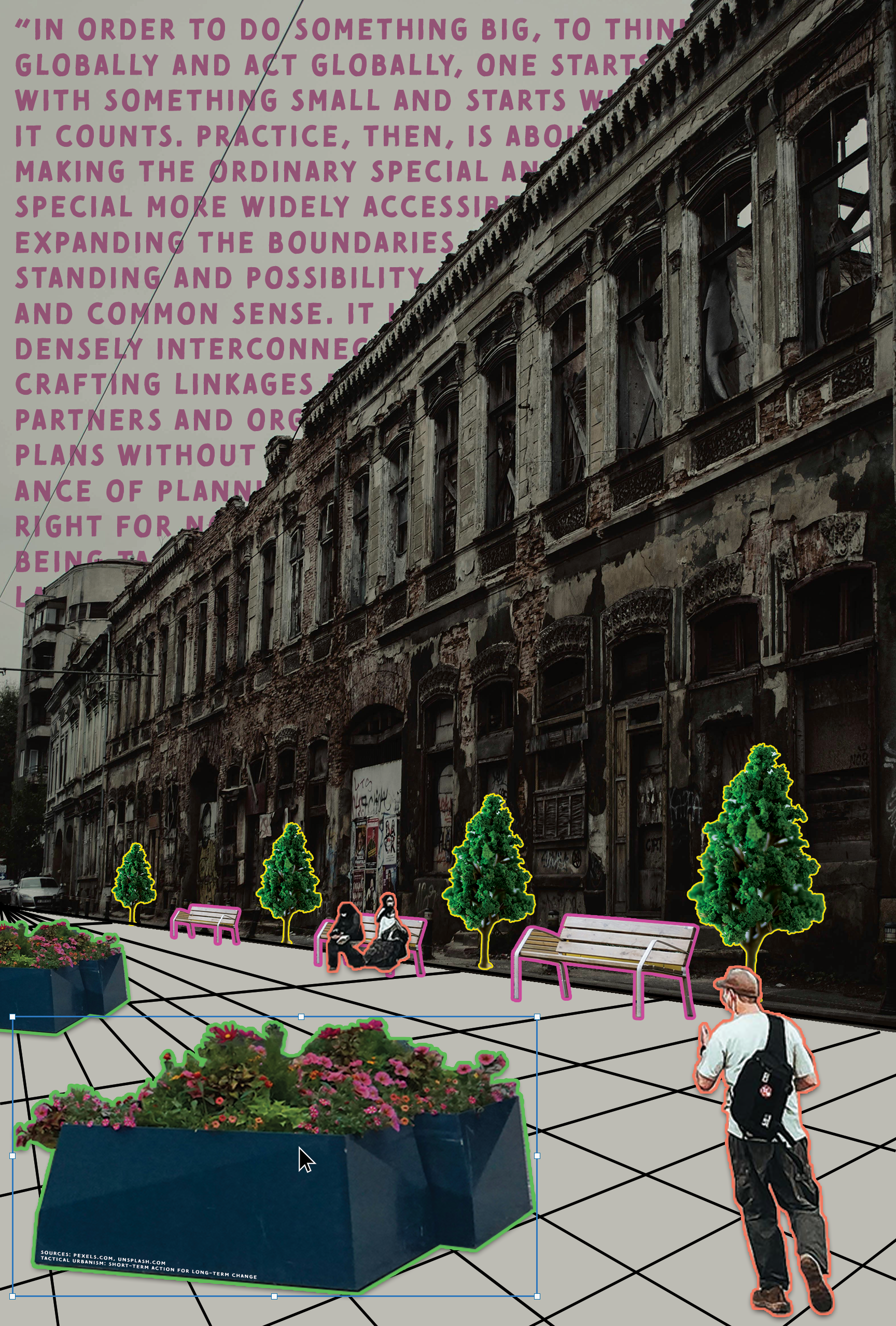
The goal of this visual essay was to create a poster based on a short research paper on a topic of my choice, focusing on how the visuals work with the accompanying verbal messages to convey meaning, offer new ways of knowing. With the research being about tactical urbanism, I wanted to show a space that could use intervention and give a DIY vibe to said intervention. I chose to use the backdrop of a decaying city street as if it were contained in some combination of Photoshop and the build mode of The Sims, with plants, furniture, and people being placed into the environment to spruce it up. In the sky is an excerpt of a quote used in the essay, which I felt encapsulated the idea of tactical urbanism.
The written essay:
When thinking about transforming underutilized or forgotten city spaces, it may be tempting to think that big, sweeping actions are what we need. However, there is value to starting with small, simple interventions first:
“...in order to do something big, to think globally and act globally, one starts with something small, and one starts where it counts. Practice, then, is about making the ordinary special and the special more widely accessible — expanding the boundaries of understanding and possibility with vision and common sense. It is about building densely interconnected networks, crafting linkages between unlikely partners and organizations, and making plans without the usual preponderance of planning. It is about getting it right for now and at the same time being tactical and strategic about later. This is not about forecasting, nor about making decisions about the future. But it is about the long range, about making sure that one plus one equals two or three, about being politically connected and grounded, and about disturbing the order of things in the interests of change.” —Nabeel Hamdi
Tactical urbanism is a concept that has been used for decades to help communities shape their neighborhoods to suit their needs. This essay will explore what tactical urbanism is, provide a real-world example leading to larger-scale permanent improvements, and will conclude by considering the potential challenges and strengths of the tactical approach compared to strategic urban planning and how these approaches might be used in tandem to create lasting transformations in our cities.
At its core, tactical urbanism is about experimenting with low-cost, temporary changes to a community space, done in response to residents’ needs. These interventions are meant to be human-centric, allowing residents to reclaim their neighborhoods—the work is typically done by community members themselves or at least with their consultation. Starting with these small changes allows for quick prototypes of solutions to be tried out (and adjusted as needed) to get a sense of what works best before more costly, permanent changes are made. Several case studies have shown this incremental approach to be an effective way to transform city spaces and inspire other cities to implement similar actions.
One such example is the Better Block Project, which started out with a group of neighbors in Dallas transforming one neglected block into a vibrant community space with bike lanes, pop-up markets and food vendors. This was done through donated materials and volunteers working together, circumventing the official process of working with the city, however the project was so successful that it led to permanent zoning and regulation changes. The Better Block Project became a model for such transformations and has since grown into a nonprofit organization that guides other communities around the United States in revitalizing their neighborhoods.
While tactical urbanism offers the advantage of being quick, inexpensive, and more flexible to testing and readjustment than more official and permanent approaches, it also comes with some challenges. The DIY nature of many tactical urbanism projects mean it can be more difficult to plan and coordinate, assemble resources, and execute than traditional urban planning. Since these interventions often sidestep permitting and regulation, there are risks of liability and safety issues. There’s also no guarantee that there will be buy-in to more permanent versions of these changes. There is, however, value to testing out small changes first to reduce overall waste of time, money, and resources—then using the feedback and insights gathered to implement more sustainable and durable changes. It’s especially important to ensure community members truly have a seat at the table and have a say in what happens in their neighborhood. With that in mind, the integration of tactical urbanism methods into the urban planning process is something worth considering.
Sources:
Lydon, M. Garcia, A. Tactical Urbanism: Short-term action for long-term change. Washington DC: Island Press, 2015.
Vallance, S. Edwards, S. “Charting New Ground: Between Tactical Urbanism and Strategic Spatial Planning.” Planning Theory & Practice, 22.5 (2021): pgs. 707-724.
Moran, R. Berbary, L. “Placemaking as Unmaking: Settler Colonialism, Gentrification, and the Myth of “Revitalized” Urban Spaces.” In Leisure Myths and Mythmaking. London: Routledge, 2022.